
How to Lose Weight Without Counting Calories (and What a Low-Friction Tracker Changes)
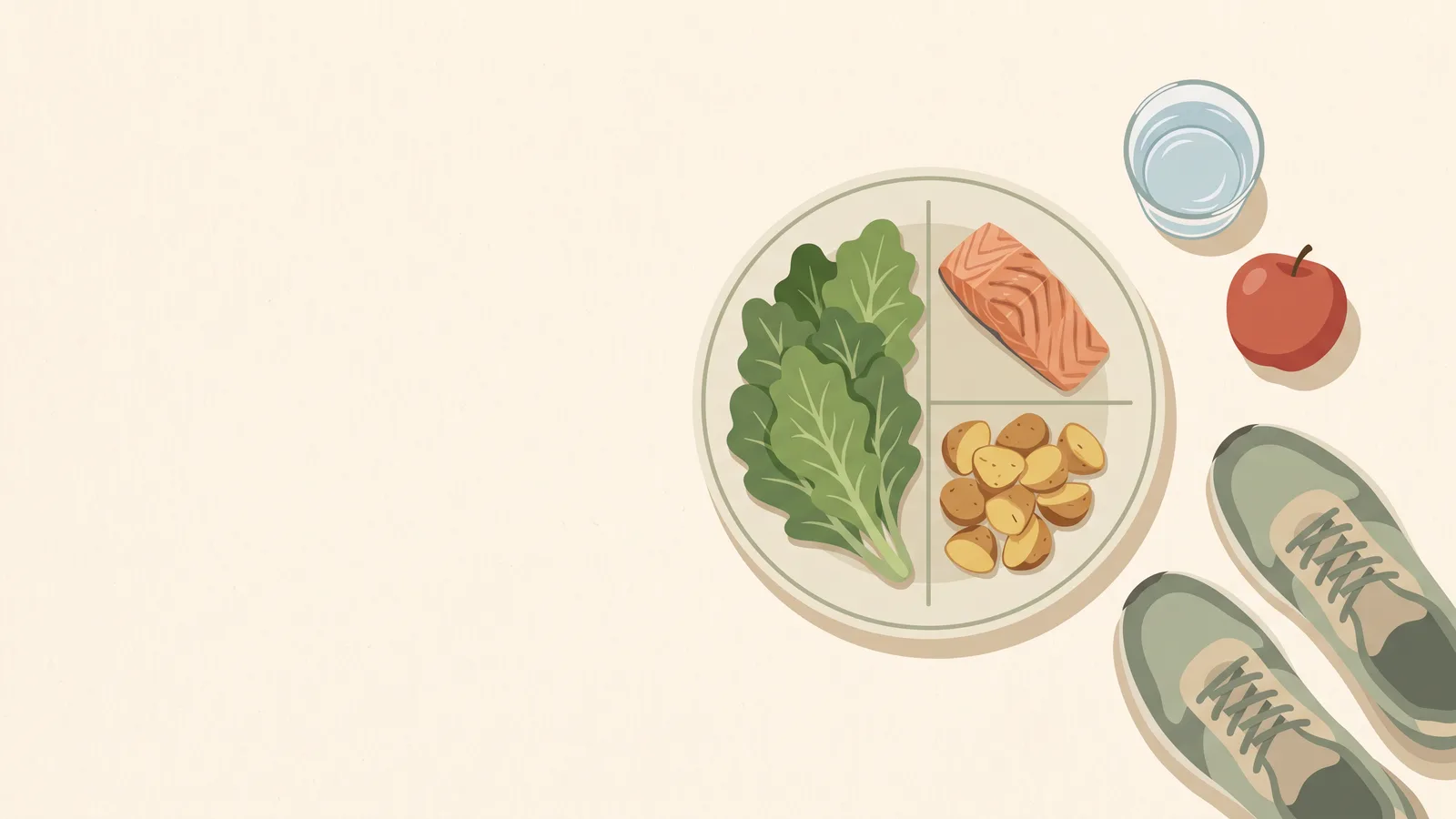
Yes, you can lose weight without counting calories, and most people who have ever lost weight did it that way. The method is not mysterious: anchor meals on protein, fill the plate with food that weighs a lot and carries little energy, stop drinking calories, eat roughly the same things at roughly the same times, weigh yourself, and sleep. Each of those moved intake in a trial where people ate as much as they wanted, laid out below. The method also has a failure mode that nobody advertises, and it is worth knowing about before month three.
Anchor every meal on protein
If you keep one rule, keep this one. In a 2005 University of Washington study 19 adults were moved from a diet with 15 percent of energy from protein to one with 30 percent, carbohydrate held constant, then told to eat as much as they liked for 12 weeks. Nobody counted anything. Spontaneous intake fell by 441 kcal a day on average and the group lost 4.9 kg, most of it fat. That is a large effect for a rule that fits in one sentence.
In practice: a palm-sized portion of something high in protein at each meal — eggs, fish, chicken, tofu, skyr, cottage cheese, lentils — eaten first. Breakfast is where most people are short. You do not need a gram target; you need the portion to be there every time.
Volume: eat the heavy, wet food
People eat a fairly constant weight of food from day to day, so the energy per gram on the plate decides a lot. In a year-long trial from Barbara Rolls' lab, 97 women with obesity were counselled either to cut fat, or to cut fat and add water-rich foods, mainly fruit and vegetables, with no calorie goals in either group. After a year the fruit-and-vegetable group had lost 7.9 kg against 6.4 kg, ate a greater weight of food, and reported less hunger. They lost more by eating more, measured in grams.
Fibre gets the credit; the picture is more modest. A 2013 systematic review of 107 acute fibre treatments found that only 39 percent reduced appetite and only 22 percent reduced how much people ate; oat and barley beta-glucan and whole rye held up, most sources did not, so a fibre supplement is not the lever. Eat vegetables, fruit, potatoes, oats and pulses because they are heavy, watery and slow to eat; the volume does the work.
Processing matters on its own. In the 2019 NIH inpatient trial 20 adults ate as much as they wanted from either an ultra-processed or an unprocessed menu for two weeks, then swapped; the menus were matched for calories offered, energy density, macronutrients, sugar, salt and fibre. On the ultra-processed menu they ate 508 kcal a day more and gained 0.9 kg; on the unprocessed one they lost 0.9 kg. Small study, tight design, simple rule: food that looks like the thing it came from is easier to stop eating.
Stop drinking calories
Liquid energy registers weakly. A half-litre of cola is around 210 kcal, a large latte on whole milk around 200, a glass of wine 120 to 150, a fruit juice about the same as the cola — and none of them shrinks the next meal. Two a day is the entire deficit most people are trying to create. The rule is a default, not abstinence: water, tea or coffee with a splash of milk during the day, and whatever you actually enjoy on purpose rather than by habit. Drop the daily juice and latte and you have removed 300 to 400 kcal without touching a meal.
Decide once: a fixed meal structure
Every food decision made hungry is made badly, and a day contains dozens of them. So make fewer: the same breakfast on weekdays, lunch from two or three options you know work, dinner from a short rotation. It sounds dull, and after a fortnight you stop noticing.
For the meals you do not plan, use the plate: half vegetables or salad, a quarter protein, a quarter starch, and fat in a thumb-sized amount you add yourself rather than find already in the dish. Eat the protein and vegetables first, the starch last; seconds are vegetables. Crude, but it is the portion method used across much of clinical dietetics, and it survives restaurants, buffets and your mother-in-law's kitchen, which is where counting collapses.
Weigh yourself, and read the trend, not the day
Not counting food need not mean measuring nothing. In a 2015 analysis of a six-month trial, 47 overweight adults were given connected scales; the half who weighed every day lost 6.1 kg more than the half who weighed most days — 5.4 days a week on average — and adopted more weight-control habits. A small secondary analysis cannot prove the scale caused the loss, but the mechanism is plain: a number you see each morning steers the day.
Weight swings a kilo or more with salt, carbohydrate, the bathroom and the menstrual cycle, so compare this week's average with last week's, never one day with another. Falling by a quarter to half a kilo a week means the rules are working. Flat for three weeks means something needs to change.
If the number on the scale sets your mood for the day, or you notice yourself eating less and less to move it, skip the scale, use how your clothes fit, and talk to a clinician who works with eating. Balance, not restriction, is the point of this page; a method that costs you your relationship with food is not a good method.
Sleep is a food decision
People skip this because it does not feel like a diet. In a 2022 randomised trial at the University of Chicago, 80 adults with a BMI between 25 and 29.9 who habitually slept under six and a half hours were given a single sleep-hygiene counselling session or nothing — no diet, no exercise programme, living at home. The counselled group slept about 1.2 hours more per night and ate 270 kcal a day less, measured not by diaries but by doubly labelled water, the most accurate method there is, and lost weight relative to the controls without being told to change a meal.
If you sleep six hours and snack at 22:00, the snack is not a willpower problem. Move the bedtime first and see what happens to the snack.
Where this fails, honestly
Everything above nudges intake down without measuring it, and it fails when the nudge is smaller than the gap. The first group is anyone with a small margin. A woman of 160 cm with a desk job might maintain at around 1,700 kcal; losing at a sensible rate means eating around 1,300 to 1,400. That 300-kcal window is a handful of nuts, two tablespoons of olive oil on the salad, a bowl of granola, or the milk in three coffees. All healthy foods, none visible to a plate method — which is why someone can genuinely eat well for months and not move.
The second failure is drift. Portions grow a little each week, the "splash" of oil becomes a pour, the weekend leaks into Thursday, and none of it registers because nothing is written down. A 1992 study in the New England Journal of Medicine looked at ten people who were sure they ate under 1,200 kcal a day and could not lose weight. Their metabolism was normal, within 5 percent of predicted. They were underestimating what they ate by 47 percent on average and overestimating their activity by 51 percent, and they were not lying. Everybody's memory of their own eating is a flattering edit, and a method built on memory inherits that.
So the honest test is the scale trend. If three weeks of the rules above produce nothing, the answer is not more discipline, and almost certainly not eating below your resting metabolic rate. It is finding out where the calories are, once, and going back to not counting.
The middle ground: a two-week audit, not a lifestyle
There is a version of counting without arithmetic: you photograph the plate or say what you ate into a chat, and something else does the looking up and the adding. It is still counting — the result is a number — but the daily cost drops to a few seconds, which changes what it is good for.
Disclosure: Olivka is our product and this is what it does, so read the next paragraph as a description of one approach rather than a neutral recommendation. It is a free trial followed by a paid subscription, and we will not pretend otherwise to readers who did not come here to buy a tracker.
Olivka works inside WhatsApp, Messenger, Telegram or Instagram. You send a photo, a voice note or a sentence; a vision model reads the plate, the ingredients are matched against USDA FoodData Central and Open Food Facts, and you get an itemised meal card you can confirm or correct — "there was mayo in it too" replaces the earlier entry rather than adding to it — plus a running daily total. A photo cannot see the oil in the pan, so it estimates; when that estimate is good and when it is not is written up separately, and among the no-app options describing the meal in words is often the more accurate one.
The use we would suggest is an audit, not a lifestyle. Log everything, honestly, for two weeks, changing nothing on purpose. At the end you will know where your 300 kcal live — the oil, the nuts, the Thursday — and you can fix that one thing and stop logging. For a number to compare against, the calorie calculator gives a maintenance estimate in the browser, nothing stored, rounded to 10 kcal because the equation is not more precise than that. And if the audit turns you into someone who wants to keep counting, the guide to doing it without letting it take over is the next thing to read.
If the audit shows you want a number after all, how to count calories to lose weight covers the deficit size and the pace worth holding.
Which approach suits which person
None of these is the virtuous option; they are tools for different distances between where you are and where you want to be.
| Your situation | Start with | Add if it stalls | Probably skip |
|---|---|---|---|
| A lot to lose, big appetite, eats a lot of packaged food | Protein anchor, unprocessed swaps, no liquid calories | Daily weigh-in trend | Counting, at least at first |
| Last 5–8 kg, small frame, already eats "healthy" | Plate method plus a two-week photo or voice audit | Weighing the oils and nuts for a week | Long-term daily logging |
| Lost weight before, regained it | Fixed meal structure, sleep, weekly weight average | A short audit each time the trend goes flat | Any plan with a finish line |
| Scale or numbers affect mood or eating | Protein, volume and sleep only, clothes as the measure | A clinician who works with eating | Weighing and counting altogether |
Whichever row you are in, the floor is the same: do not eat below your resting metabolic rate, and if you are pregnant, breastfeeding, managing a medical condition or have a history of disordered eating, talk to a clinician before changing how you eat. These rules are for people with a wide margin for error. If yours is narrow, borrow someone's expertise rather than more of your own willpower.
Frequently asked questions
Can you really lose weight without counting calories?
Yes, and there is trial evidence for each part of the method. In a 2005 study, raising protein from 15 to 30 percent of energy cut spontaneous intake by 441 kcal a day and produced 4.9 kg of loss in 12 weeks with no counting. In a year-long trial, women who added water-rich fruit and vegetables lost 7.9 kg versus 6.4 kg while reporting less hunger. Sleep extension alone reduced intake by 270 kcal a day in a 2022 randomised trial. The method fails when your calorie margin is small enough that healthy, energy-dense foods like nuts and oil quietly close it.
Why am I not losing weight even though I eat healthy?
Usually because healthy and low in energy are different properties. Nuts, olive oil, avocado, granola, dried fruit, cheese and full-fat dairy are all reasonable foods with a lot of calories per gram, and a plate method does not see them. Portions also drift upward over weeks without registering. A 1992 study of people certain they ate under 1,200 kcal found they were underestimating intake by 47 percent on average, with normal metabolisms, and were not lying. A two-week honest log usually locates the gap; you can then fix that one thing and stop logging.
Should I weigh myself every day if I am not counting calories?
For most people, yes, provided you read the weekly average and not the daily number. In a 2015 analysis of a six-month trial, adults who weighed daily lost 6.1 kg more than those who weighed most days, and adopted more weight-control habits. Weight swings a kilo or more with salt, carbohydrate and the menstrual cycle, so compare this week to last week. The exception is anyone for whom the scale drives mood or restriction: use how clothes fit instead, and consider talking to a clinician who works with eating.
Is logging meals by photo the same as counting calories?
The output is the same, a number, but the cost is not. Typing foods and weights into an app forty times a week is what makes most people quit; sending a photo or a voice note takes seconds, and the tool does the matching and adding. That makes it practical as a short audit, two weeks of honest logging to find where your calories actually are, rather than as a permanent habit. A photo still cannot see cooking oil or judge a portion precisely, so the estimate is an estimate, and describing the meal in words often does better.